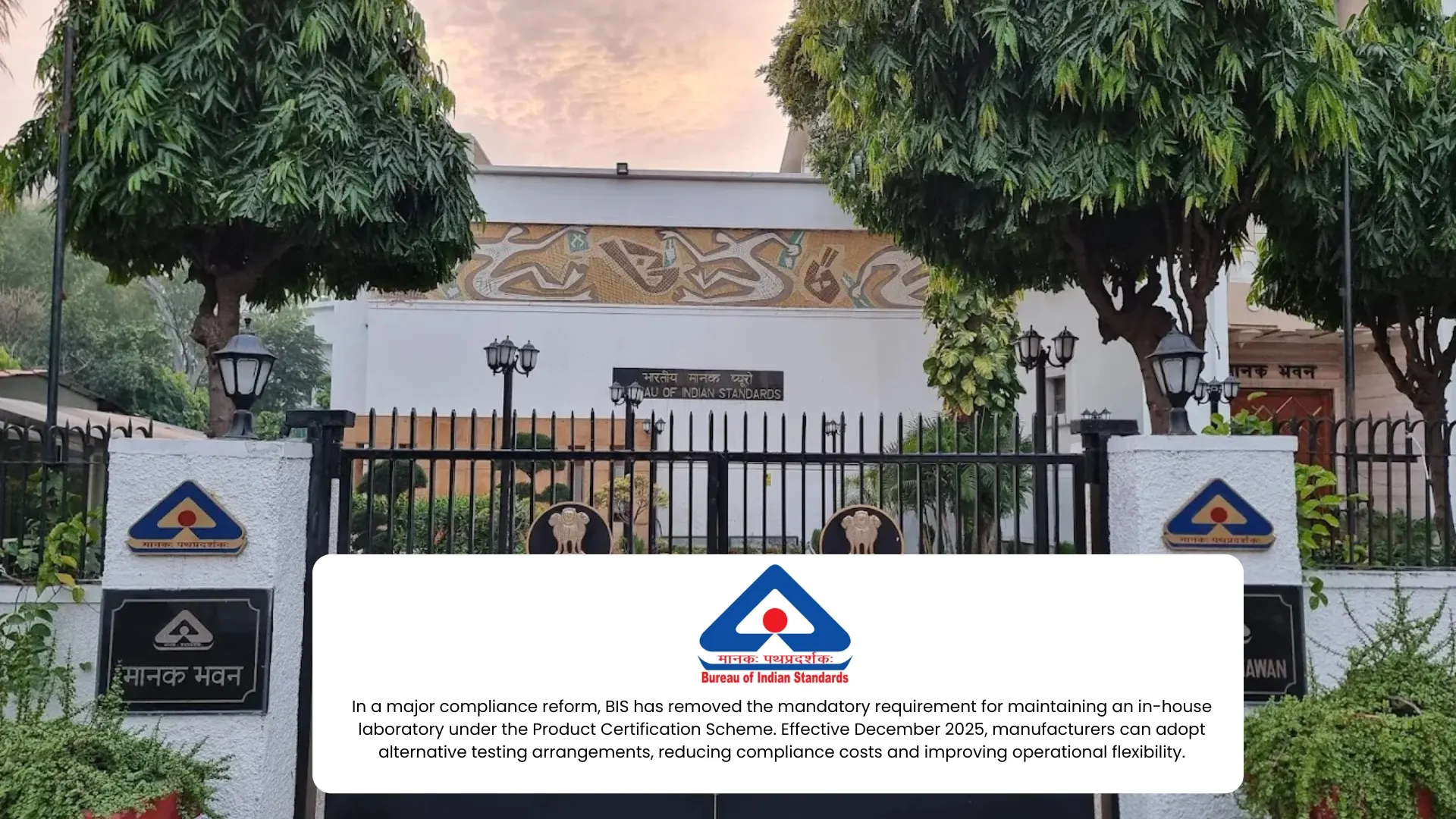
The Bureau of Indian Standards (BIS) has issued a significant regulatory update that brings major relief to manufacturers operating under the BIS Product Certification Scheme. As per the latest circular issued by the Central Marks Department-I on 16 December 2025, maintaining an in-house laboratory is no longer mandatory for BIS certification.
This move is aimed at simplifying compliance, reducing operational costs, and providing manufacturers with greater flexibility in meeting quality and testing requirements.
What Has Changed?
Previously, manufacturers were required to maintain an in-house testing laboratory as part of BIS certification compliance. With this new circular:
- There is no longer any obligation to maintain an in-house laboratory
- Manufacturers can now choose from multiple alternative testing arrangements
Permitted Alternatives to In-House Testing
Manufacturers may now comply with BIS testing requirements through the following options:
1. Shared Testing Facilities
Common facilities shared among multiple manufacturers
2. Cluster-Based Testing Facilities
Industry cluster laboratories set up for collective use
3. Sub-Contracting Testing to External Laboratories, including:
BIS recognised or empanelled laboratories
Any laboratory accredited as per ISO/IEC 17025
This flexibility allows manufacturers, especially MSMEs and startups, to significantly reduce infrastructure and compliance costs.
Quality Assurance Plan (QAP) – Greater Autonomy for Manufacturers
The circular also clarifies that:
- The Scheme of Inspection and Testing (SIT) provided in BIS product manuals is now recommendatory, not mandatory.
- Manufacturers are free to define and declare their own Quality Assurance Plan (QAP).
- The declared QAP must ensure that products continue to comply with the applicable Indian Standards.
This change empowers manufacturers to design quality systems best suited to their production processes.
Products Exempted from This Relaxation
The revised provisions do not apply to the following categories:
- DPIIT / PESO regulated products under pre-dispatch or lot inspection
- Cement products regulated by DPIIT (Cement Desk)
- Food products
- Protective helmets for two-wheeler riders
- Products where BIS certification operates solely on factory testing basis as per product- specific guidelines
Manufacturers dealing in these categories must continue following existing testing requirements.
Effective Date & Supersession
- The circular comes into force with immediate effect
- It supersedes the earlier circular dated 16 July 2024
What This Means for Manufacturers
This progressive decision by BIS:
- Reduces compliance burden and capital expenditure
- Encourages ease of doing business
- Supports MSMEs and emerging manufacturers
- Maintains product quality while allowing flexible compliance models
Manufacturers should review their current testing arrangements and update their compliance strategy accordingly.
Need Help with BIS Compliance?
If you need assistance in:
- Updating your Quality Assurance Plan (QAP)
- Selecting approved or accredited testing laboratories
- Obtaining or modifying BIS certification
Our compliance experts are here to help. Contact us today for end-to-end BIS certification support.