BIS Notifies 19 New and Revised Indian Standards: Key Updates Effective July 2026
The Bureau of Indian Standards (BIS) has issued a comprehensive list of new and revised Indian Standards in its notification under the Bureau of Indian Standards Rules, 2018, Rule 15(1).
The notification introduces 19 Indian Standards, including some updates to the existing standards in various sectors such as safety footwear, solar, food-grade materials, cement, plastics, agriculture machinery, infrastructure, irrigation, handmade paper, health care.
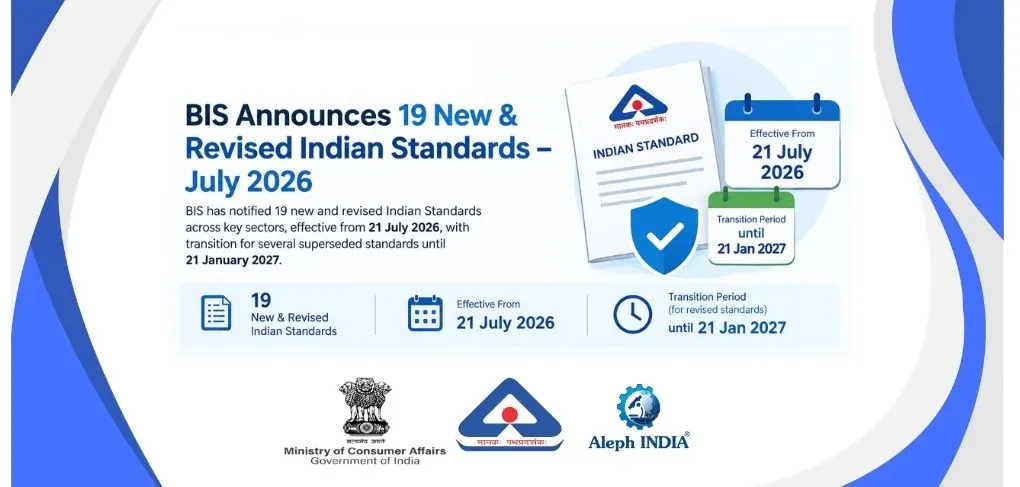
The standards will take effect from 21 July 2026. For the standards that are in revision, the previous versions of the standards will still be in effect concurrently up to the withdrawal date as specified in the standard, which is mainly 21 January 2027.
What Does the BIS Notification Cover?
The latest notification includes:
- 16 revised/new standards replacing or updating earlier editions.
- 3 newly established standards for which no previous standard is listed for withdrawal.
- A transition period for several superseded standards until 21 January 2027.
This provides manufacturers, importers, testing laboratories, certification bodies and other stakeholders with a defined period to transition to the latest requirements.
Major Standards Established by BIS
1. IS 1989 (Part 1):2026 – Leather Safety Boots and Shoes for Miners
BIS has established IS 1989 (Part 1):2026, the fifth revision covering specifications for leather safety boots and shoes for miners.
The previous edition, IS 1989 (Part 1):1986, will be withdrawn on 21 January 2027.
2. IS 1989 (Part 2):2026 – Safety Footwear for Heavy Metal Industries
The fifth revision of IS 1989 (Part 2):2026 establishes specifications for leather safety boots and shoes intended for heavy metal industries.
The earlier IS 1989 (Part 2):1986 will remain concurrently applicable until its withdrawal on 21 January 2027.
3. IS 2553 (Part 3):2026 – Safety Glass for Solar Applications
BIS has introduced the first revision of IS 2553 (Part 3):2026 – Safety Glass — Specification, Part 3: Solar Applications.
The earlier IS 2553 (Part 3):2019 is scheduled for withdrawal on 21 January 2027.
This revision is particularly relevant to manufacturers and suppliers operating in the solar-energy and safety-glass sectors.
4. IS 5306:2026 – Food-Grade Sodium Carboxymethyl Cellulose
The third revision of IS 5306:2026 covers Sodium Carboxymethyl Cellulose, Food Grade.
The previous IS 5306:1996 will be withdrawn on 21 January 2027.
5. IS 5867:2026 – Leather Board for Footwear Insoles
BIS has established the first revision of IS 5867:2026, covering leather board used for footwear insoles.
The previous IS 5867:1970 is scheduled for withdrawal on 21 January 2027.
6. IS 6452:2026 – High Alumina Cement
The second revision of IS 6452:2026 establishes specifications for High Alumina Cement for Structural Use.
The earlier IS 6452:1989 will be withdrawn on 21 January 2027.
7. IS 7324:2026 – Brix Hydrometers
The second revision of IS 7324:2026 covers specifications for Brix hydrometers.
The previous IS 7324:1983 will be withdrawn on 21 January 2027.
Important Revision in Polyethylene Material Standard
One of the notable updates is IS 7328:2026 – Polyethylene (PE) Material for Moulding and Extrusion — Specification, which is the third revision.
The previous IS 7328:2020 and IS 10146:1982 are listed for withdrawal on 21 January 2027.
Manufacturers dealing with polyethylene materials for moulding and extrusion should review the revised standard and assess their existing specifications, testing and quality-control procedures before the transition deadline.
Other Standards Revised by BIS
The notification also covers the following standards:
| Standard | Subject | Status |
| IS 7585:2026 | Wines – Methods of Test | Second Revision |
| IS 8122 (Part 1):2026 | Combine Harvester – Terminology | Second Revision |
| IS 8122 (Part 2):2026 | Combine Harvester – Test Code | Second Revision |
| IS 9374:2026 | Flour Milling Industry – Glossary | First Revision |
| IS 11233:2026 | Foundations for Radar, Satellite Tracking, Microwave, Mobile & TV Towers | First Revision |
| IS 15284 (Part 1):2026 | Ground Improvement – Stone Columns | First Revision |
| IS 15284 (Part 2):2026 | Ground Improvement – Preconsolidation Using Vertical Drains | First Revision |
| IS 17425:2026 | PE Pipes & Fittings for Sprinkler Irrigation Systems | First Revision |
These revised standards were established on 21 July 2026, while the corresponding earlier editions are generally scheduled for withdrawal on 21 January 2027.
Three New Standards Established Without Earlier Standards for Withdrawal
The notification also establishes three standards where no earlier Indian Standard is listed for withdrawal:
IS 19535:2026
ISO 3036:2025 – Board — Determination of Puncture Resistance Using a Pendulum Device
This standard was established on 21 July 2026.
IS 19655 (Part 6):2026
Handmade Paper — Specification, Part 6: Certificates
This standard establishes requirements relating to certificates for handmade paper.
IS 19792:2026
Pharmacovigilance Centre for Ayurveda, Siddha, Sowa-Rigpa, Unani and Homoeopathy (ASU & H) Systems — Service Requirements
The standard specifies service requirements for pharmacovigilance centres covering the ASU & H systems.
Transition Period for Superseded Standards
A key point for industry stakeholders is the transition period.
For the revised standards listed in the notification, the new editions were established on 21 July 2026, while the earlier editions are generally scheduled to be withdrawn on 21 January 2027.
This means businesses using the existing editions should use the transition period to:
- Review the applicable revised Indian Standard.
- Identify changes in technical requirements.
- Review product specifications and drawings.
- Evaluate testing requirements.
- Update quality-control procedures.
- Assess existing BIS certification documentation, wherever applicable.
- Coordinate with testing laboratories for revised testing requirements.
- Ensure production and inspection processes are aligned with the latest edition.
The notification specifically provides that the earlier standards will continue concurrently until their respective withdrawal dates.
What Manufacturers and Importers Should Do
The establishment of a revised Indian Standard does not by itself mean that every product covered by the standard immediately becomes subject to mandatory BIS certification.
Whether BIS certification, a BIS licence, Standard Mark or other regulatory compliance is mandatory depends on the applicable Quality Control Order (QCO), BIS scheme, product-specific regulation or other government notification.
Therefore, manufacturers and importers should distinguish between:
Indian Standard established by BIS
and
Mandatory compliance requirement under a government regulation/QCO.
Where a product is already covered by a mandatory BIS certification requirement, stakeholders should assess whether their existing licence, test reports, product documentation and manufacturing controls need to be updated to the revised standard.
Key Takeaway
The BIS notification dated 23 July 2026 represents another important update to India's standardisation framework, with 19 Indian Standards established or revised across a wide range of industries.
For most revised standards, the earlier editions have been given a transition period until 21 January 2027. Businesses should therefore begin reviewing the applicable revised standards well before the withdrawal deadline rather than waiting until the final transition date.
Early assessment can help manufacturers identify changes in testing, product specifications, documentation and certification requirements and plan the transition smoothly.
Aleph INDIA can assist manufacturers, importers and businesses in understanding applicable BIS requirements, assessing revised standards, preparing compliance documentation and navigating BIS certification requirements.