
Note
For detailed information about the Procedure for
BIS ISI Certification, visit:
Lorem ipsum dolor sit amet, consectetur adipiscing elit, sed do eiusmod tempor incididunt ut labore
When we are a manufacturer, we always want to increase our market share and brand values. In this competitive scenario, it isn't easy to survive in the market without a standard quality and certified product. BIS license may also be required to sell product in Indian market.
To get BIS certification and produce a standard quality product, ensure that your product must follow the specified Indian Standard for that product.
Let's take a closer look at IS 15298(Part 2):2016 for safety footwear.
Safety footwear is covered under IS 15298(Part 2):2016. This Standard specifies the basic and additional requirements for safety footwear.
When we are a manufacturer, we always want to increase our market share and brand values. In this competitive scenario, it isn't easy to survive in the market without a standard quality and certified product. BIS license may also be required to sell product in Indian market.
To get BIS certification and produce a standard quality product, ensure that your product must follow the specified Indian Standard for that product.
Let's take a closer look at IS 15298(Part 2):2016 for safety footwear.
Safety footwear is covered under IS 15298(Part 2):2016. This Standard specifies the basic and additional requirements for safety footwear.
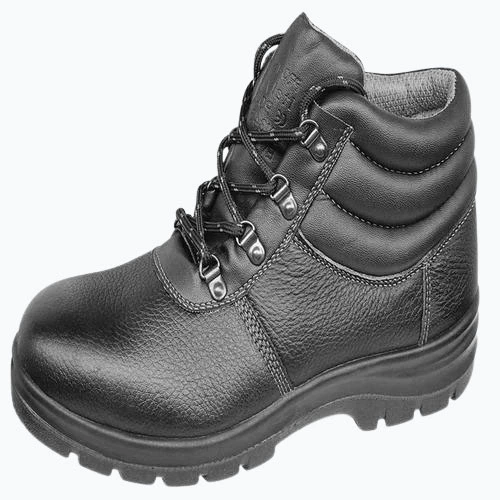
Safety footwear incorporates protective features to protect the wearer from potential injuries caused by accidents. It is equipped with toecaps and is designed to protect against compression when tested at a compression load of at least 15 KN and against impact when tested at an energy level of at least 200 J.
Classification of footwear: According to the Indian Standard, footwear is classified using the following code designations:
| Code designation | Classification |
|---|---|
| I | Footwear made from leather and other materials, excluding all-rubber or all-polymeric footwear. |
| II | All-rubber (i.e. entirely vulcanized) or all-polymeric (i.e. entirely moulded) footwear. |
Safety footwear must meet the basic requirements outlined in the Standard. Footwear must conform to one of the designs specified in this specification. When used, an insole must be installed so that it cannot be removed without causing damage to the footwear. Toecaps must be built into the footwear so that they cannot be removed. Depending on the risks experienced in the workplace, additional requirements for safety footwear may be required. In such instances, safety footwear must meet the additional requirements and related markings outlined in the Standard.
A laboratory must be maintained and properly equipped and staffed, where various tests shall be performed in line with the techniques specified in the specification.
The following major tests shall be required for safety footwear:
The Standard Mark (ISI Mark) must be applied on each piece of safety footwear and the outer packaging for each pair of footwear provided that the footwear to which this mark is thus applied meets all of the specification's requirements. All markings must be made inside the tongue or on the top outer face of the boot to cause the least amount of damage while working. Each item of safety footwear must also be clearly and permanently marked with the information specified in the Standard. The Manufacturer must obtain a BIS license from the Bureau of Indian Standards to use a standard mark (ISI Mark). The BIS grants a license based on a successful assessment of manufacturing infrastructure, quality control and testing capabilities, and production process.
A streamlined process designed to ensure compliance, quality, and efficiency at every step.
Preparation and submission of required documents.
Filing the application with BIS along with applicable fees.
Inspection and evaluation of manufacturing facility.
Testing of product samples in BIS recognized laboratory.
Successful evaluation and grant of BIS ISI Mark license.

Watch our detailed video to understand each step involved in obtaining BIS ISI Mark Certification.
For detailed information about the Procedure for
BIS ISI Certification, visit:
The estimated time frame for obtaining BIS certification under IS 15298(Part 2):2016 is:
If a product falls under the scope of the BIS Conformity Assessment Scheme, All the manufacturers, importers, and foreign entities must obtain BIS ISI Certification. The Bureau may cancel the License if the product fails to meet certification requirements.
Aleph INDIA has been serving the industry as a single-window operator for all product regulatory compliance. We can assist importers or manufacturers in meeting all criteria for importing or selling a product in the Indian market.

Partner with Aleph INDIA to simplify your BIS certification journey and ensure full compliance with IS 15298(Part 2):2016 for robust and high-performance packaging solutions.

 India
India Mr.Yogesh K.T. representing “Aleph India,” addressing the audience in a “FOSG – Aleph India” Joint Seminar. Here he is sharing his innovative ideas to keep t...

 Japan
Japan Another Successful Audit completed by the Bureau of Indian Standards (BIS)! Proud moment for Aleph INDIA Group as our client, M/S JX Metals Smelting Co., Ltd...

 Vietnam
 Another Successful Audit completed by the Bureau of Indian Standards! Proud moment as Aleph INDIA Group's client, M/S. BENCHMARK INDUSTRIES COMPANY LIMITED (...
Hear from industry leaders who have experienced the
impact of partnering with
Aleph.

 Aleph INDIA
Sr. Sales Manager
IVicon Security Tech Private Ltd
Aleph INDIA
Project Manager | Remidio
Innovation Solutions Pvt Ltd
Aleph INDIA
CEO | Makercubs
Technologies Pvt Ltd
Aleph INDIA
Technical Vice President |
AIR LIQUIDE MEDICAL SYSTEMS PRIVATE LIMITED