Note
For detailed information about the Procedure for
BIS ISI Certification, visit:
Lorem ipsum dolor sit amet, consectetur adipiscing elit, sed do eiusmod tempor incididunt ut labore
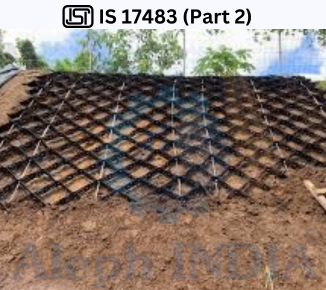
BIS certification is essential for Geocells used in slope erosion protection as per IS 17483 (Part 2): 2020. This standard ensures that geocells meet stringent quality and performance criteria for preventing soil erosion on slopes, embankments, and other geotechnical applications. Certification guarantees that these geosynthetic materials undergo rigorous testing for tensile strength, durability, cell integrity, and resistance to environmental degradation, ensuring their effectiveness in stabilizing slopes and preventing soil displacement. Compliance with IS 17483 (Part 2): 2020 reflects a manufacturer’s commitment to producing high-quality geocells that contribute to sustainable and resilient infrastructure.
This standard specifies the technical requirements and testing methods for geocells used in erosion control applications. It defines critical performance parameters such as mechanical strength, flexibility, seam integrity, and resistance to weathering, UV exposure, and hydraulic forces. Geocells play a crucial role in reinforcing soil structures, enhancing vegetation growth, and preventing soil loss in environmentally sensitive areas. The testing procedures ensure that these materials provide reliable performance in diverse environmental conditions, making them indispensable for infrastructure, environmental conservation, and land restoration projects.
| Product Name | Geosynthetics - Geocells - Slope Erosion Protection |
| Applicable Indian Standard | IS 17483 (Part 2): 2020 |
| Applicable Certification Scheme | Product Certification Scheme (ISI Mark Scheme) Scheme 1 - Schedule 2 |
| Compliance Requirement | Mandatory |
| Quality Control Order | View QCO |
| Scope as per Standard | This standard, IS 17483 (Part 2): 2020, specifies the material properties and technical requirements for high-density polyethylene (HDPE) geocells used in slope erosion protection applications. It covers their use in highway and railway embankments, earthen embankments, landfill closure slopes, and lined slope protection. |
BIS certification under IS 17483 (Part 2): 2020 ensures compliance with national quality standards, enhancing product credibility and market acceptance. For manufacturers, certification provides regulatory compliance, a competitive edge, and increased trust from clients. For end users, certified geocells offer assured strength, durability, and stability, ensuring reliable performance in infrastructure projects such as highways, railways, riverbanks, and slope stabilization systems. Certification also facilitates approval processes for government and private-sector projects requiring high-quality erosion control solutions.
A streamlined process designed to ensure compliance, quality, and efficiency at every step.
Preparation and submission of required documents.
Filing the application with BIS along with applicable fees.
Inspection and evaluation of manufacturing facility.
Testing of product samples in BIS recognized laboratory.
Successful evaluation and grant of BIS ISI Mark license.
Watch our detailed video to understand each step involved in obtaining BIS ISI Mark Certification.
For detailed information about the Procedure for
BIS ISI Certification, visit:
The estimated time frame for obtaining BIS certification under IS 17483 (Part 2): 2020 is:
BIS certification under IS 17483 (Part 2): 2020 is crucial for ensuring the quality, strength, and performance of geocells used in slope erosion protection. Adhering to this standard enables manufacturers to supply high-performance geosynthetics that meet industry and regulatory requirements.
Partner with Aleph INDIA for expert assistance in obtaining BIS certification and ensuring compliance with national standards for geocells.

Partner with Aleph INDIA to simplify your BIS certification journey and ensure full compliance with IS 17483 (Part 2): 2020 for robust and high-performance packaging solutions.
BIS certification ensures that geocells meet the required quality and performance standards for effective slope erosion control. It verifies their strength, durability, and resistance to environmental factors, ensuring their reliability in infrastructure and environmental projects.
The standard includes tests for tensile strength, seam integrity, flexibility, weathering resistance, UV stability, and hydraulic performance to ensure the geocells provide long-term stability in erosion-prone areas.
For Indian manufacturers, the certification process takes approximately 30 days, while for foreign manufacturers, it may take around 180 days, depending on factory inspections and testing approvals.
Manufacturers need to submit an application, provide product samples for testing, and undergo factory inspections. Partnering with Aleph INDIA can streamline the process and ensure smooth compliance with BIS requirements.

 Indonesia
 Another Successful Audit completed by the Bureau of Indian Standards! Proud moment as Aleph INDIA Group's client, M/S. PT. Permata Hijau Palm Oleo, Indonesia...

 Vietnam
 Another Successful Audit completed by the Bureau of Indian Standards! Proud moment as Aleph INDIA Group's client, M/S. BENCHMARK INDUSTRIES COMPANY LIMITED (...

 Malaysia
 A successful BIS Audit was conducted by the Bureau of Indian Standards on SOUTHERN STEELS in Malaysia. Under the BIS - ISI audit, SOUTHERN STEELS in Malaysia...
Hear from industry leaders who have experienced the
impact of partnering with
Aleph.

 Aleph INDIA
Sr. Sales Manager
IVicon Security Tech Private Ltd
Aleph INDIA
Project Manager | Remidio
Innovation Solutions Pvt Ltd
Aleph INDIA
CEO | Makercubs
Technologies Pvt Ltd
Aleph INDIA
Technical Vice President |
AIR LIQUIDE MEDICAL SYSTEMS PRIVATE LIMITED